
Getting a handle on your own finances seems daunting, especially when the industry’s jargon is unfamiliar. (That’s why you leave it to the pros, right?) But having a basic understanding of some common financial terms can help you navigate your finances a little better and save you some time to focus on investing or nurturing your small business.
This comprehensive (but non-exhaustive) glossary of essential financial terms can clear up some questions you have about your personal finances. Of course, if you have any more questions, we’re always here to help.
Financial Terms: Learn Them, Use Them
When you dive into financial documents, you come across jargon that may go over your head if you’re new to it. We’re providing a list of the basics to get you started, so you don’t have to get a degree in finance to understand what your money does.
Whether you’re investing, saving, or wanting to secure a loan, having a grasp of financial terminology enhances your clarity and understanding when you look at your complex banking details or talk to an adviser.
Maybe you can impress a few people with these fancy words, too.
Banking & Credit Terminology
Assets
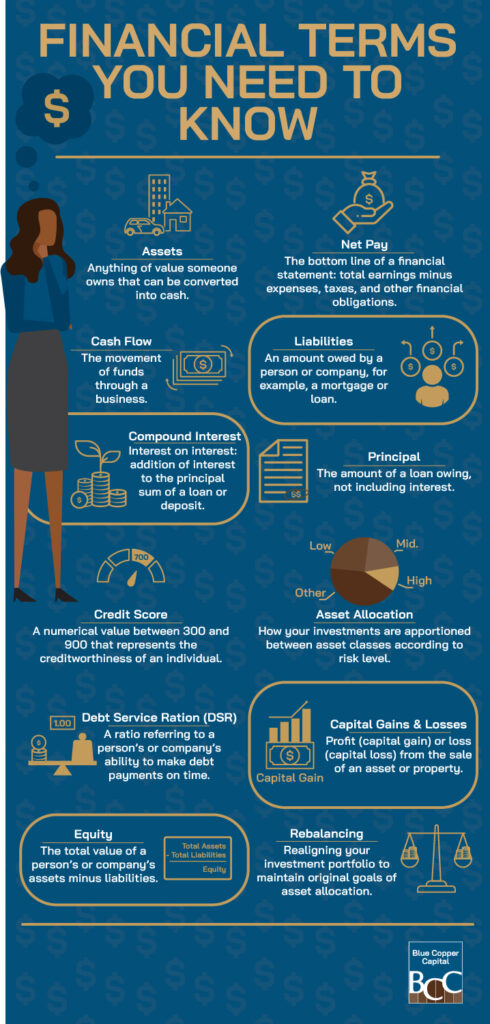
Simply put, assets are anything of value that you own that can be converted into cash or have future benefits. Examples of personal assets include your car, house or land, investments, or personal property.
Business assets break down into current assets and fixed assets. Current assets are short-term things like cash, inventory, and accounts receivable, which can be converted into cash within a year. Companies own fixed assets used for services and production and to generate long-term income, like company vehicles, machinery, or land.
Cash Flow
Cash flow describes the movement of money in and out of your business. For example, cash inflows would be funds coming into your business from clients and customers or any other cash received. Cash outflows are funds spent on expenses like payroll, rent, taxes, and utilities.
Compound Interest
Think of compound interest as interest on interest. Compounding interest can be a benefit when you’re saving or investing: the interest earned compounds on the original amount plus any interest already earned. On the other hand, if you’re paying off a debt with compound interest, the interest is charged on the outstanding balance plus any accumulated interest.
When you secure a line of credit from Blue Copper Capital, you’ll benefit from simple, non-compounding interest.
Credit Score
Your credit score shows your credit management skills and what risks a lender would be taking to lend you money. It’s a 3-digit number ranging from 300 to 900, created from a summary of your credit history (credit report).
Many factors are considered to calculate your credit score, including how long you’ve had credit, your credit payment habits, any outstanding debts, and any record of bankruptcy, consumer proposal, and certain types of debt consolidation.
Lenders set their own guidelines for the minimum credit score required to secure a loan. Get in touch with us to learn more about your credit score and discuss how we can help you reach your financial goals.
Debt Service Ratio (DSR)
Also known as the debt-service coverage ratio (DSCR), this ratio measures the ability of a person or business to pay current debt obligations. This number is used by lenders, investors, or potential partners to assess the financial status of a person or business.
Equity
Your equity describes the total funds that belong to a person or business, taking into account all assets and financial obligations (liabilities). You can determine equity by subtracting total liabilities from total assets.
For example, if you own a house and a car totalling $750,000 in asset value but have an outstanding mortgage balance of $500,000, your equity would be $250,000.

Net Pay
Your net pay refers to revenue minus expenses, interest, and taxes. Your personal net pay refers to total earnings less applicable taxes and deductions. To determine the net pay for a business, start with the total revenue and subtract operating costs, business expenses, and taxes.
Fun fact: the term “bottom line” comes from net pay, as it’s the last line you see on a financial statement.
Liabilities
Liabilities are financial obligations, also known as an amount owing. This financial term refers to debts accrued from loans, mortgages, accounts payable, bonds, or accrued expenses. In business, liabilities are generally accounted for in opposition to assets.
Principal
If you have a loan or are interested in applying for a loan, you’ve probably heard this financial term before. The principal is the amount of a loan remaining.
For instance, if you borrowed an installment loan of $5000, this initial amount is the principal. Then, let’s say you pay off $2000 of your loan, the remaining $3000 becomes the principal. Interest on the loan is separate and additional.
Investing Terminology
Asset Allocation
Where are you putting your money when you invest? You choose your risk tolerance for investing, and your asset allocation is how you apportion your funds. The ultimate goal of asset allocation strives to maximize your return by balancing your funds over several asset classes.
Capital Gains & Losses
In the investing world, the term capital gains describe a profit from the sale of shares or property. Capital gains can be short- or long-term and must be reflected on your taxes as taxable income.
Capital losses, on the other hand, refer to a deficit after the sale of shares, which can decrease your tax obligation but also means that your account sees a loss.
Rebalancing
Rebalancing refers to the practice of keeping your investment portfolio on track. For example, if you started with an asset allocation of 50% equities and 50% cash, but one has increased over time, rebalancing helps maintain the original goal. This is done periodically by buying or selling assets, mitigating unwanted risk.
From Basic to Boss
This non-exhaustive list should clear things up on your financial journey, but the industry continues to evolve. So, stay up-to-date with our blog, and always feel free to contact us. We live and breathe finance, and we’re here to answer your questions.